'%20fill='%23fff'/%3e%3c/svg%3e)
'%3e%3crect%20id='Rectangle_7260'%20data-name='Rectangle%207260'%20width='20'%20height='20'%20transform='translate(-56%20-54)'%20fill='none'/%3e%3cg%20id='Group_13372'%20data-name='Group%2013372'%3e%3cg%20id='Ellipse_302'%20data-name='Ellipse%20302'%20transform='translate(-54%20-52)'%20fill='none'%20stroke='%23707070'%20stroke-width='2'%3e%3ccircle%20cx='7'%20cy='7'%20r='7'%20stroke='none'/%3e%3ccircle%20cx='7'%20cy='7'%20r='6'%20fill='none'/%3e%3c/g%3e%3cline%20id='Line_2'%20data-name='Line%202'%20x2='4'%20y2='4'%20transform='translate(-42.5%20-40.5)'%20fill='none'%20stroke='%23707070'%20stroke-width='2'/%3e%3c/g%3e%3cpath%20id='Union_29'%20data-name='Union%2029'%20d='M11.192,12.606a7,7,0,1,1,1.414-1.414l3.6,3.6-1.414,1.414ZM2,7A5,5,0,1,0,7,2,5.005,5.005,0,0,0,2,7Z'%20transform='translate(-54%20-52)'%20fill='%23fff'/%3e%3c/g%3e%3c/svg%3e)
'%20fill='%23fff'/%3e%3c/svg%3e)
08 October 2026, Taipei, Taiwan – Demonstrating its strong forward-looking R&D capabilities, two fundamental theoretical studies from the Hon Hai Research Institute, under Hon Hai Technology Group (Foxconn), have been accepted by the IEEE Symposium on Foundations of Computer Science (FOCS 2026), universally recognized as the highest distinction in theoretical computer science.
The 67th Annual FOCS 2026 will take place from November 8-11, 2026, in New York City, USA. As a flagship conference hosted by IEEE, FOCS stands alongside ACM's STOC as the premier academic venue in global theoretical computer science. The conference focuses on underlying mathematical theories such as algorithm design, computational complexity, cryptography, and quantum computing.
The
studies were conducted by Min-Hsiu Hsieh, Director of HHRI’s Quantum Computing
Research Center, Researcher Michael de Oliveira, Intern Ding-Jun Lin, Intern Adam
Wills, and an international collaborative team have both. The two accepted
papers—"Worst-case depth hierarchy for shallow quantum circuits"
(arXiv:2606.16425) and "Linear-Time Encodable and Decodable Quantum
Error-Correcting Codes" (arXiv:2603.04543)—are not only the annual
flagship achievements of the Hon Hai Research Institute’s Quantum Computing
Research Center, but FOCS itself is a top-tier global theoretical computer
science conference with an extremely high acceptance threshold. Notably, among
all papers accepted by FOCS this year, Hon Hai Research Institute is the sole
research entity representing Taiwan, fully highlighting Foxconn’s leadership in
key foundational infrastructure for next-generation quantum technology.
Mapping the Limits of Quantum Computational Power to Guide Algorithm Design
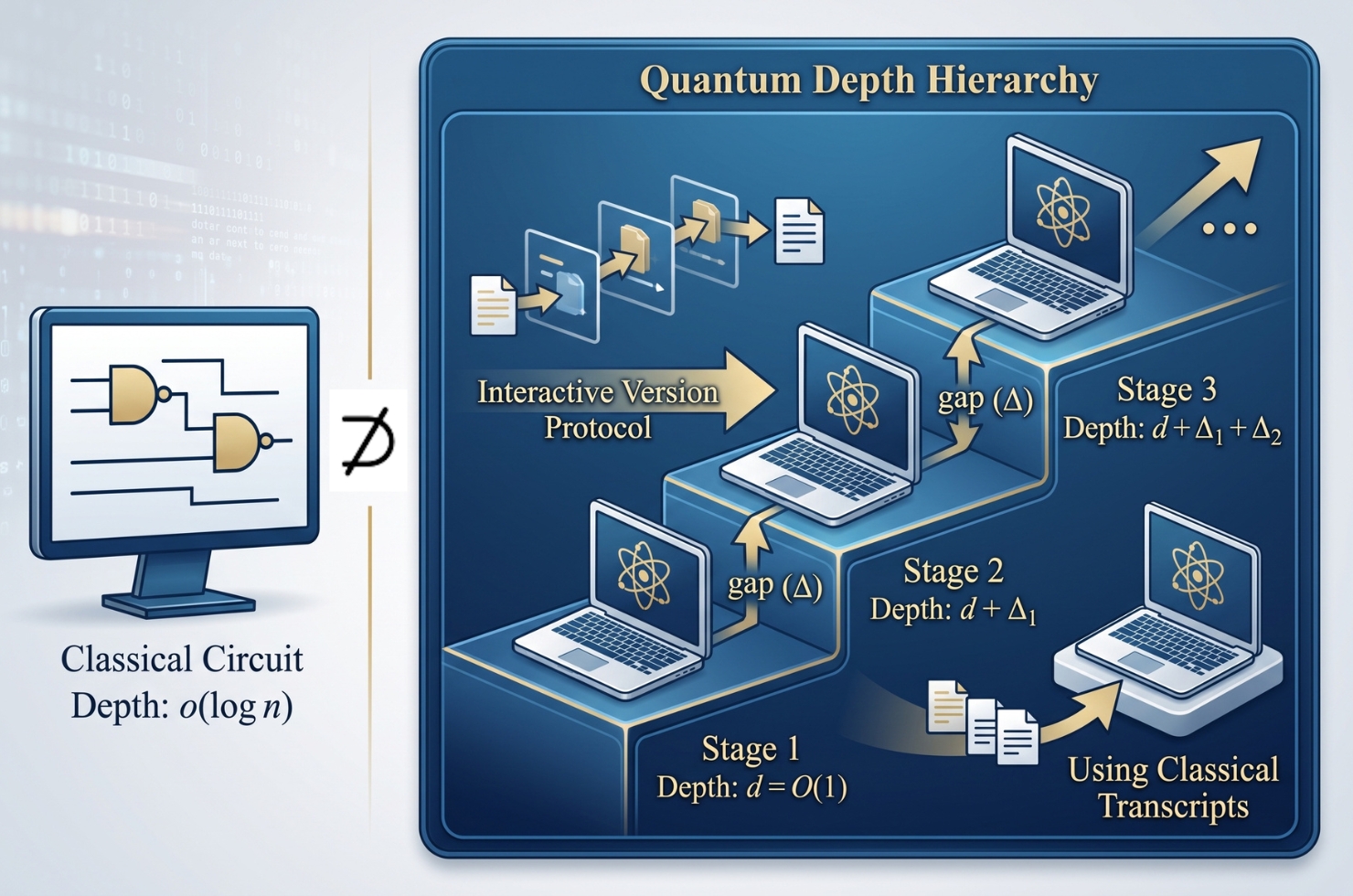
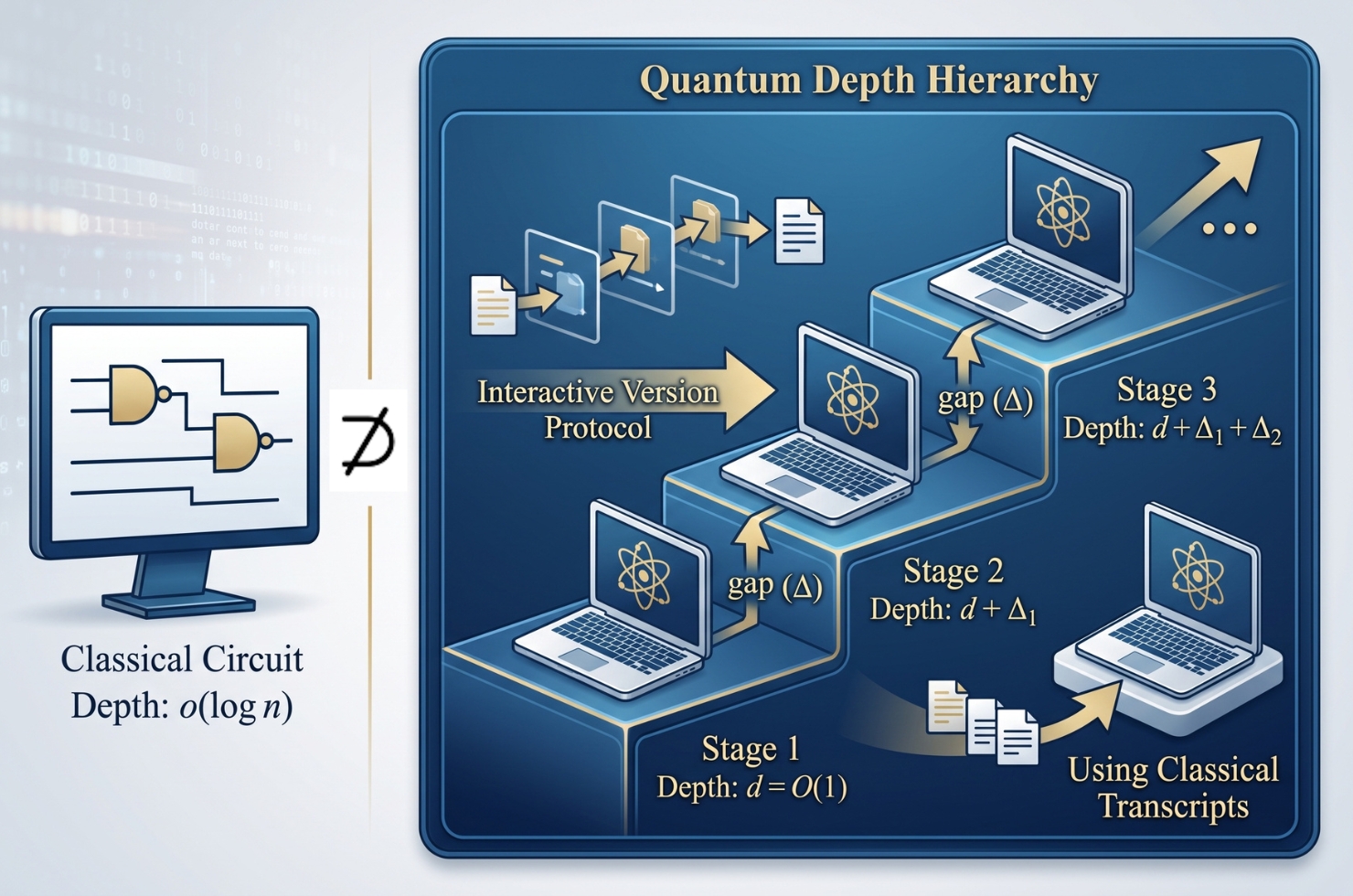
The first accepted paper, "Worst-case depth hierarchy for shallow quantum circuits," focuses on the "depth hierarchy theory for shallow quantum circuits."
In quantum computing, "circuit depth" resembles the total number of sequential steps that must be executed (equivalent to run time). Current quantum hardware, limited by technology, can only execute "shallow computations" with few steps and short run times. However, the scientific community has historically struggled to rigorously prove precisely how much of a leap in quantum computational capability occurs if the run time is increased by just a few additional steps.
HHRI’s research team successfully established a mathematical framework that rigorously proves that for every additional layer of computational steps, the problem-solving domain of a quantum computer exhibits a distinct "hierarchical jump." This result is akin to mapping a precise "quantum computational capability chart," helping scientists worldwide clearly grasp the boundaries of current quantum devices, enabling the development of more efficient algorithms, and accelerating the realization of high-performance quantum computers.
Equipping Qubits with "Ultra-Fast Protective Armor" to Build Ultra-Low Latency Error-Correction Technology
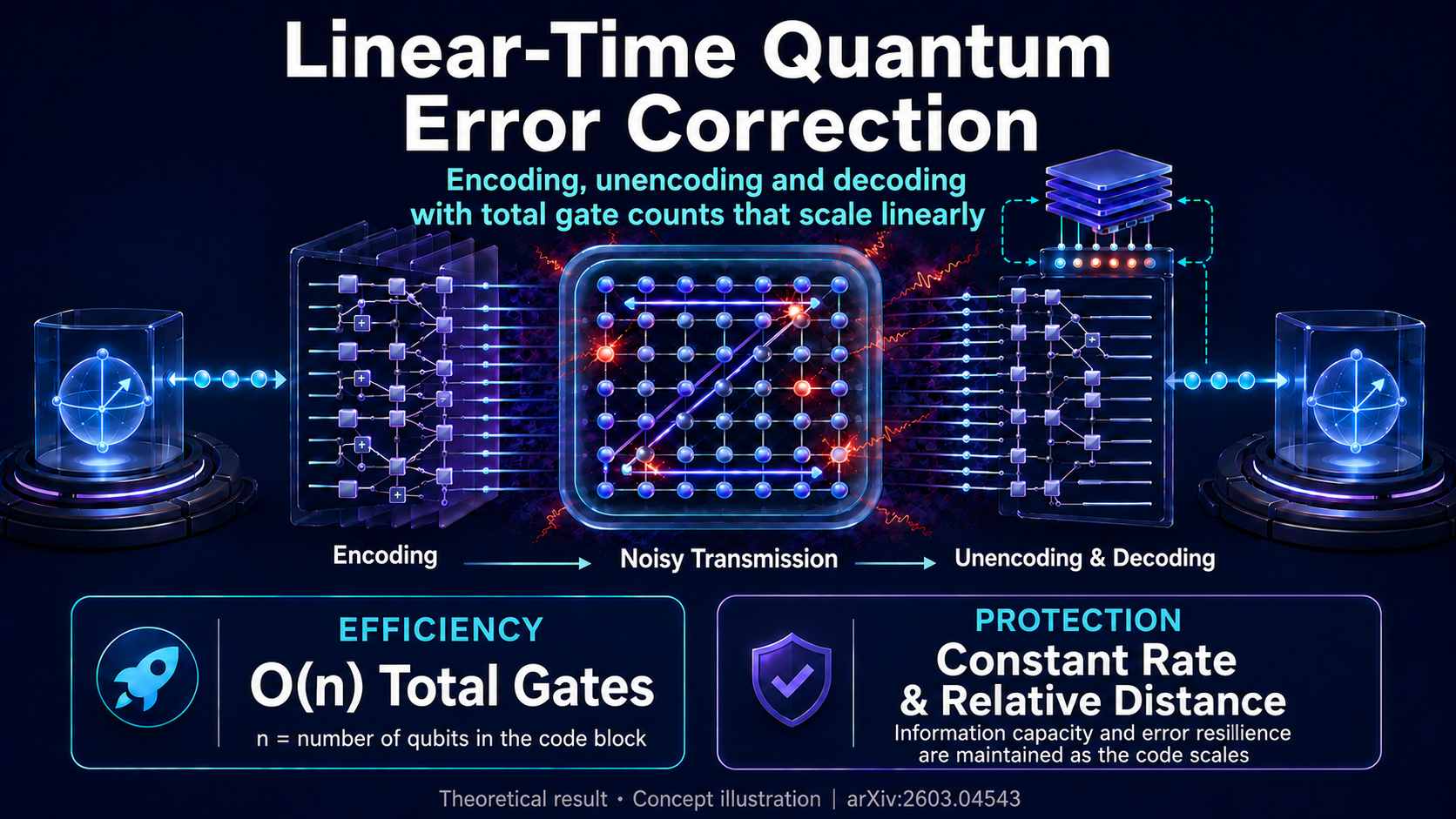
The second paper, "Linear-Time Encodable and Decodable Quantum Error-Correcting Codes," tackles the most challenging noise issue in quantum computing—"linear-time encodable and decodable quantum error-correcting codes."
While quantum computers possess immense processing power, qubits are extremely fragile. Minor temperature fluctuations or noise interference from the surrounding environment can instantaneously collapse the computational information. Therefore, quantum computers must detect and repair errors in real time within extremely short timeframes. However, if the computation for error correction and encoding is overly complex and time-consuming, qubits will degrade before the errors can even be fixed.
The Quantum Computing Research Center team successfully developed an innovative encoding and decoding architecture that vastly simplifies the correction process, allowing computers to complete error-correction in highly efficient "linear time." This breakthrough is like equipping qubits with smart armor capable of "instant self-repair," laying a crucial cornerstone for building large-scale, stably operating quantum computers and quantum communication networks in the future.
Cultivating
Foundational Theory to Lead Next-Generation Technology
Quantum technology is regarded as the core technology set to disrupt future cybersecurity, materials science, finance, and artificial intelligence. Yet, every hardware engineering breakthrough must be built on a foundation of underlying mathematics and algorithmic theory.
HHRI director Hsieh stated that being the sole selection from Taiwan at this top-tier conference not only demonstrates that Taiwan's research in quantum foundational theory has reached world-class standards, but also confirms Foxconn’s commitment to cultivating advanced science and nurturing young scientific talent. Moving forward, the Quantum Computing Research Center will continue to collaborate with world-class research teams to provide the most solid theoretical support for next-generation technological infrastructure.